When the Customer Journey Happens Outside Your Website.
For two decades, the website was the centre of digital marketing. AI search and agents are moving that centre — and brands need to adapt.
For two decades, the website has been the centrepiece of digital marketing. The hub where marketers direct campaigns, customer journeys are designed, conversions are tracked, and promises are made.
That centre is now shifting.
AI search, assistants, and agents are increasingly shaping what people see, what they trust, and what they buy. They do not provide a long list of options. They deliver an opinion, a shortlist, or even a completed transaction. Intermediaries are absorbing traffic that once flowed to a brand's own site.
This development is still fluid. Google, OpenAI, Amazon, and Apple are all experimenting. But the direction is clear. Journeys are fragmenting, decisions are being made earlier, and websites are losing their monopoly on conversion.
The question is no longer only how you drive people to your site. The question is how your brand presents itself in the spaces where agents make decisions.
In a recent keynote for ANFO, I organised my reflections around three themes that, taken together, outline what brands must adapt to in this new environment.
Positioning in the agentic era.
Positioning has traditionally been a battle for space in the consumer's mind. Today, it is also a battle within the logic of intermediaries like Perplexity, Amazon Rufus, Microsoft Copilot, and ChatGPT. To be positioned means to be chosen by the agent, not only remembered by the human.
This is where a new discipline is emerging: Answer Engine Optimisation (AEO). If search once meant being visible in ten blue links, AEO means being one of the three answers that an AI engine puts forward. The implication is brutal. If you are not in the answer, you are invisible.

Monetisation will complicate this further. These platforms will inevitably integrate paid placement, shifting performance marketing from clicks to agent-preferred recommendations. Positioning, therefore, becomes dual. It must live in the consumer's perception and in the machine's ranking logic.
Brand promises under machine scrutiny.
Campaigns and slogans no longer suffice. In an AI-driven journey, brand promises must be verifiable and consistent across surfaces.
That means sustainability claims backed by structured certifications. Delivery times reflected accurately in product feeds. Return policies and warranties presented as data, not fine print. Reviews and earned media serve as additional proof.
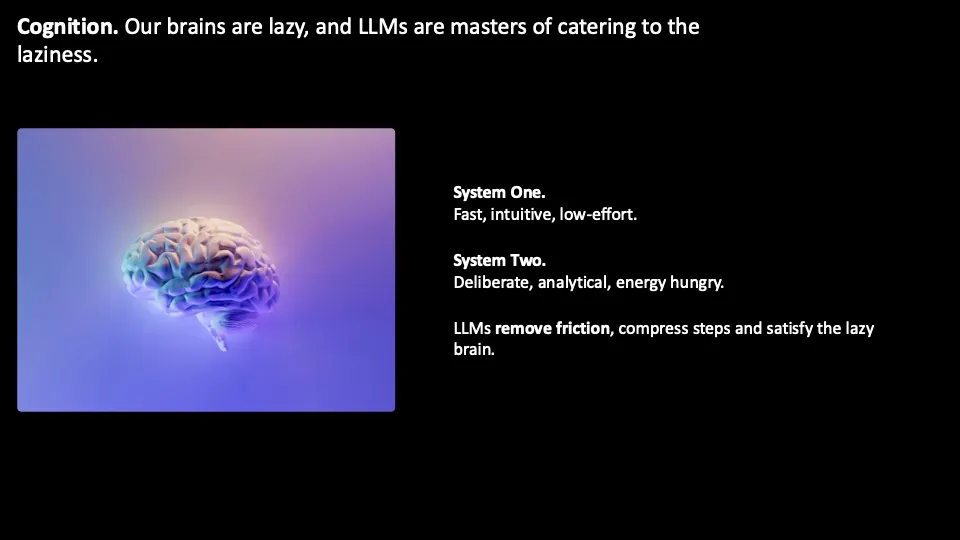
The human side of this equation is also changing. Psychologists Daniel Kahneman and Amos Tversky described how people rely on two systems of thought. System 1 is fast and intuitive; System 2 is slow and analytical. AI assistants are optimised for System 1 — frictionless, one-tap answers. However, for high-stakes purchases, brands must also provide System 2 evidence, including transparent comparisons, trade-offs, and citations.
Tone of voice and conversational identity add a further layer. Inconsistency between chatbot, campaign and review is amplified, not hidden. Because AI outputs feel authoritative, reputation risks are sharper than before.
Loyalty as embedded utility.
Loyalty is also shifting. Points and perks still exist, but the deeper trend is towards utility. Being embedded in the customer's daily flow: automatic replenishment, warranties, service tiers, and anticipatory shipping.
Loyalty signals also feed visibility. Reviews, repeat purchases, and word-of-mouth all strengthen a brand's presence in search engines. Loyalty is no longer only retention. It is also a driver of discovery.
We may even see a counter-movement. If AI commoditises browsing, physical stores could regain importance as spaces of experience and differentiation.
The task ahead.
The website is not dead, but it is no longer the gravitational centre for marketing — which, for some of us, is a sad thought. The challenge for brands is to urgently adapt their positioning, promises and loyalty to an environment where algorithms and agents mediate journeys.
This means measuring differently. Not only clicks, but also whether you are chosen as an answer.
It means structuring your brand as data — including reviews, product feeds, specifications, policies, and sustainability information.
And it means playing in ecosystems: building partnerships, becoming OS-legible, and embedding loyalty as a service.
The customer journey outside your website is not an abstract concept for the future; it's a tangible reality. It is unfolding now. The brands that succeed will be those that not only persuade people but also teach the machines why they are the best answer.